Using different email addresses for your work and personal life is not just a good idea, it is a critical part of modern digital security. We have all felt that spark of panic: Did I just send that sarcastic comment to a client? Is my boss seeing notifications for my online shopping?
When you mix your personal and professional lives in one inbox, you create a single point of failure. It is a house of cards. A mistake in one area (like a weak password for a store) can bring your entire professional life crashing down.
This guide is not a gentle suggestion. It is an expert-backed plan. As an SEO and content expert, I have seen the digital disasters that happen when this line is blurred. We will cover the risks, the benefits, and a simple “how-to” strategy for creating a secure, professional, and sane email system.
What Does Using “Different Email Addresses” Mean?
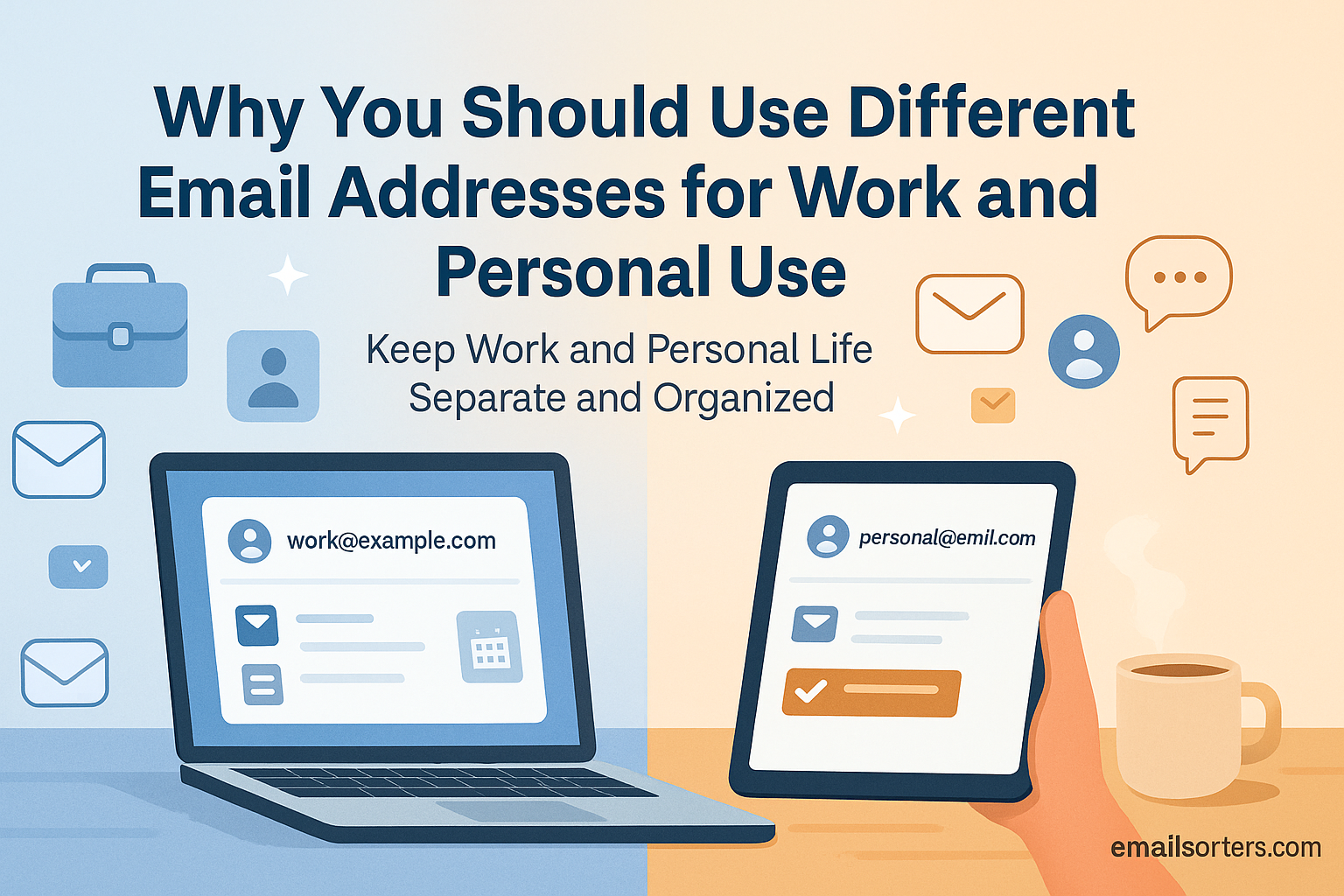
Using different email addresses means creating at least two separate accounts: one exclusively for your professional life (work, clients, networking) and another strictly for your personal life (family, friends, subscriptions).
Think of them as digital buckets. Your “work” bucket is for professional communication. It is owned (or should be) by a company, even if that company is you. Your “personal” bucket is for everything else.
This separation is the foundation. We will build on this. Most people should actually have three or four accounts. This article will show you why.
Why Can’t I Just Use One Email for Everything?
Using one email for everything creates massive security risks, destroys your work-life balance, and looks unprofessional. It mixes your personal data with company property, putting both you and your employer at risk
A single, “all-in-one” inbox is a sign of a digital beginner. It might seem easier, but it is not. Every notification is a gamble. Every email you send is a potential “reply-all” disaster. Every account you create is another link in a chain, and a single weak link can break it.
Let’s dig into the specific, real-world reasons why this is a terrible idea.
1. The Professionalism Argument: Why One Inbox Looks Bad
First impressions are digital. Before a client ever meets you, they see your email address. What is yours saying about you?
How Does a Mixed Inbox Damage Your Professional Image?
A mixed inbox damages your image by creating unprofessional-looking email addresses. Sending a client an email from [email protected] erodes trust. It signals that you are not a serious professional.
I once received a business proposal from an email address that was clearly a reference to a video game. My immediate thought? “This person is not a serious partner.”
The solution is simple. If you are a freelancer or business owner, you must have an email on a custom email domain (e.g., [email protected]). If you are an employee, you use your company’s email. If you are just starting, at least create an email account with a simple, professional name, like [email protected]. Check out these email address ideas for guidance.
What Happens When You Send a Personal Email by Mistake?
Sending a personal email to a work contact is a common disaster. It can range from embarrassing (a private joke) to catastrophic (a complaint about your boss). Separation makes this mistake almost impossible.
The “autofill” feature is not your friend here. You type “John” and it autofills with [email protected] instead of [email protected]. You hit send. The damage is done.
A client of mine once sent a heated email intended for their co-founder to their largest client. The subject line was the same for both. It was a five-figure mistake. Using different email addresses in different browsers or apps would have prevented this.
It also works in reverse. Using your work email for personal messages, and using CC and BCC to include personal contacts, creates a permanent, searchable record on a server you do not own. This is a bad idea.
2. The Security Argument: Your Biggest Digital Risk
This is the most important section. From a security standpoint, using one email for everything is like building a house with no locks on the doors.
How Does a Single Account Expose You to Hackers?
A single email is a single point of failure. If a hacker breaches your account by guessing your “favorite store” password, they get everything: your bank details, your client contracts, and your company’s private data.
Think about it. You use that one email to sign up for:
- Your bank.
- Your company’s HR portal.
- A sketchy online store for a 10% discount.
- Your social media.
That sketchy store gets breached. Hackers now have your email and password. They try that same combination everywhere. This is called “credential stuffing.”
Suddenly, they are in your inbox. They set up forwarding rules. They are reading your client emails. They are resetting your bank password. They have won.
What Is “Data Cross-Contamination”?
Data cross-contamination is when your personal data (photos, bank info) gets saved on your company’s email server and vice versa. This is a privacy nightmare and a legal landmine.
When you use your work email to sign up for your doctor’s patient portal, you are saving your private health information on your company’s server. Your IT admin can see this.
When you email a work file to your personal Gmail to “work on it at home,” you have just created an unsecured copy of a company asset. You may have violated your contract.
This mixing of data is a huge liability. You must also consider simple security, like using a strong password and enabling automatic logout on all your devices.
3. The Legal and Ownership Argument: Who Owns Your Email?
This is the part most people do not understand until it is too late. The answer is simple and brutal.
Does Your Employer Own Your Work Email?
Yes, 100%. Your company email and everything in it is the legal property of your employer. They have the right to read your emails, monitor your activity, and take it all away when you leave.
As an expert, I must be clear: you have zero expectation of privacy on a work computer or work email account.
It is in your employee handbook. Your company’s IT department can, and often does, monitor email for compliance, security, or legal reasons. Sending a personal love letter, a complaint about your boss, or your tax documents through that email is a massive, permanent mistake.
What Happens to Your Email When You Leave a Job?
When you leave a job, you lose access to your work email instantly. If your personal life (doctor’s appointments, kid’s school, airline tickets) is in that inbox, it’s gone.
I have a friend who was laid off. He used his work email for everything.
- His kid’s student email updates.
- His family email account backups.
- His mortgage application documents.
- His flight reservations for a trip next month.
His access was cut off before he even got back to his desk. He lost it all. He spent weeks on the phone trying to prove his identity to airlines and banks. It was a personal, digital disaster.
Do not let this be you. Your work email is temporary. It is rented, not owned. You must assume all inactive email accounts from old jobs are gone forever.
4. The Work-Life Balance Argument: Protecting Your Sanity
This is not a “soft” benefit. This is a real, tangible way to protect your mental health.
How Does a Single Inbox Cause Burnout?
A single inbox means you are never “off the clock.” A notification on Saturday could be a fun message from a friend or a critical fire drill from your boss. This constant alert state leads to stress and burnout.
Every “ding” from your phone creates a small spike of anxiety. “What is it now?” When your vacation plans are next to your project deadlines, your brain can never truly disconnect. You are not “working from home.” You are “living at work.”
What Is “Notification Fatigue”?
Notification fatigue is when your brain is overwhelmed by constant pings. By separating your email, you can turn off work notifications on weekends. This gives your brain a true break and respects your personal time.
This is a practical, actionable step.
- On my phone: I have the Outlook app for work. Its notifications are off from 6 PM to 8 AM and all weekend.
- On my phone: I have the Gmail app for personal. Its notifications are always on.
This simple separation is a game-changer. I am in control. When I am with my family, I am with my family. If you want to know how to do this, you can learn how to set up email on iPhone with “Focus Modes” to manage different accounts.
What Is the Best Strategy for Using Different Email Addresses?
The best strategy is a “Digital Bucket” system. Create dedicated inboxes for specific life categories. This goes beyond just “work” and “personal” and gives you total control over your digital life.
A two-email system (work/personal) is the minimum. A four-email system is for “pro” users who want maximum security and organization. It is the system I use and recommend to everyone.
Here is the 4-email system.
The 4-Email System: A Practical Guide
This system is simple, free, and will change your digital life.
| Account Type | Purpose | Analogy |
| 1. Work | Your job, clients, and networking. | The Fortress |
| 2. Personal | 1-to-1 mail with friends and family. | The Living Room |
| 3. Subscriptions | Newsletters, shopping, social media. | The Mailbox |
| 4. Finance/Security | Banking, taxes, account recovery. | The Safe |
Account 1: The “Work” Email (The Fortress)
- Purpose: This email is for your job, and only your job. It’s for clients, your boss, and professional networking.
- Rules: It should be on a custom domain if you’re a freelancer or your company’s domain if you’re an employee. You are 100% professional here. You do not sign up for anything personal with this account.
Account 2: The “Personal” Email (The Living Room)
- Purpose: This is your high-trust account for personal, 1-to-1 communication. It’s for your family, your close friends, and maybe your doctor or lawyer.
- Rules: You protect this address. You do not post it publicly. You use a professional, simple name for it (e.g.,
[email protected]). This is the account you will have for decades.
Account 3: The “Subscriptions” Email (The Mailbox)
- Purpose: This is your main “junk” or “subscription” inbox. Use this to sign up for newsletters, store loyalty cards, e-commerce, and social media.
- Rules: This account is designed to be spammed. It will receive hundreds of emails a week. This is a good thing. It is protecting your other inboxes. You only check this account when you are in the mood to shop or read. It is the ultimate defense against no-reply email newsletters.
Account 4: The “Finance/Security” Email (The Safe)
- Purpose: This is your most secure, private, and secret email. Use this only for your bank, credit cards, taxes, and as the recovery email for all your other accounts.
- Rules: NEVER. GIVE. THIS. EMAIL. OUT. You do not send email from it. You only receive email here. It should have a long, unique, and complex password, plus 2-Factor Authentication (2FA). This is the account that saves you when you get a Mailer-Daemon error trying to recover a lost account.
How to Manage All These Email Accounts
“Four accounts? That sounds like a nightmare.”
No. It is a dream. The goal is not to create more work; it is to create less work by sorting your mail before it ever hits your inbox.
What Are Email Alias Addresses?
An email alias is a simple nickname or forwarder for your main address. For example, [email protected] all goes to [email protected] but can be automatically filtered.
This is a “lite” version of the subscription account. You can use it on your personal or subscription inbox. When you sign up for “Cool Store,” you use [email protected]. You can then create a filter to send all mail from that alias to a folder. If they start spamming you, you just filter it to “Trash.”
How Do I Organize My Inboxes?
Manage your accounts with tools. Use a desktop client (like Apple Mail, Outlook), browser profiles (one for work, one for personal), or dedicated apps on your phone. The goal is to separate, not combine.
A “unified inbox” sounds nice, but it defeats the purpose of work-life balance. I recommend:
- Browser Profiles: In Chrome, I have a “Work” profile and a “Personal” profile. They have different bookmarks, logins, and themes.
- Apps: On my phone, I use the Outlook app (for work) and the Gmail app (for all personal).
- Folders: Inside each account, configure email folders (or labels) aggressively. I have filters that auto-sort 80% of my mail.
- Drafts: Use your email drafts folder as a temporary “to-do” list, but clean it out weekly.
What Is the Best Way to Handle Multiple Accounts?
The best way to handle multiple accounts is to not check them all at once. Set specific times. This is called “batch processing.”
- “Work” Email: Check during work hours only.
- “Personal” Email: Check in the morning and evening.
- “Finance” Email: Check once a week, or when you get an alert.
- “Subscription” Email: Check on Saturday morning with coffee, or when you need a coupon.
This gives you back control. You are no longer a slave to the “ding.”
What About Other Types of Email Accounts?
The separation strategy applies to other accounts in your life, too.
What About Email for Children?
An email for children should be a fifth, separate account. It must be created with parental controls (like Google Family Link) and kept separate from all your accounts. This is for their safety and your privacy. You do not want their school sign-ups mixed with your bank statements.
What About a Student Email?
A student email should be treated like a work email. It is temporary, owned by the school, and will be deleted after you graduate. Do not use it for personal sign-ups. Forward any important emails to your “Personal” account before you lose access.
Your Digital Life in Separate, Safe Buckets
Using different email addresses is not an optional “nerd” thing. It is a fundamental part of modern digital security, professionalism, and mental health. This is a core concept, as important as the fiftieth anniversary of email itself.
You now have a complete, expert-level plan. It protects you from hackers, protects you from your employer, and protects your personal time.
The best first step? Create a new email account right now. Call it your “Subscription” account. Start using it for all new sign-ups. That one 10-minute action will cut your inbox clutter in half.
For more on the history and format of email, you can read this detailed email address guide.