The first step to configure email folders is to accept that your inbox is not a to-do list. It is a receiving dock. If your inbox has 1,000 (or 50,000) unread messages, you do not have an email problem. You have a system problem.
I have seen inboxes that are digital junk drawers. I have also seen inboxes that are models of calm productivity. The only difference is a simple, automated folder system.
Folders are not just storage. They are a process. This guide will not just show you how to create a folder. It will show you a complete, expert-backed system for email management. We will cover the best folder philosophies, automation rules, and the step-by-step clicks for Gmail, Outlook, and Apple Mail.
What Are Email Folders (And Why Do They Matter)?
Email folders, also known as “mailboxes,” are digital filing cabinets inside your email account. They allow you to move emails out of your main inbox and store them in dedicated, organized categories. This cleans your inbox and makes it easier to find messages later.
The real benefit is not just organization. It is psychological.
An overflowing inbox is a constant source of stress. It is a visual representation of all the work you have not done. Every time you open it, you are hit with a wave of notifications, spam, and requests.
A clean, sorted inbox gives you control. It turns your email from a source of anxiety into a tool for productivity. It is the difference between a cluttered, unusable desk and a clean, organized workspace.
The Big Debate: Folders vs. Labels (Gmail) vs. Search
The best system uses all three. Folders and labels provide a proactive structure. Search provides a reactive way to find anything. Relying on search alone means you live in a messy room, but you are good at finding your keys.
This is a point of confusion. Let’s make it simple.
- Folders (Outlook/Apple Mail): An email can only be in one place. If you move a message to the “Invoices” folder, it is no longer in your inbox. This is a traditional, physical filing cabinet model.
- Labels (Gmail): An email can have multiple labels. A message can be labeled “Invoices,” “Client-X,” and “Urgent” all at once. It is like using colored sticky tags. Removing the “Inbox” label is the same as “Archiving.”
- Search: This is the “one giant pile” method. You never delete or file anything. You just dump everything into a single archive and trust the search bar to find it.
What Is the Best Folder System for Productivity?
The best folder system is simple and action-based. Instead of creating a folder for every topic, you create a few folders based on the action you need to take. This keeps your system clean, fast, and easy to maintain.
A bad system is one you cannot maintain. If you have 100 folders, you will waste more time filing than working.
Here are the most popular, expert-backed systems.
Method 1: The “Project-Based” System (The Architect)
This system organizes mail by topic. You create folders for every project, client, or subject. This is the most common system.
ClientsClient AClient B
ProjectsProject XProject Y
FinanceInvoicesReceipts
HR
| Pros | Cons |
| Very organized by topic. | Becomes a massive, complex mess. |
| Easy to find all mail about one client. | You spend too much time filing. |
| Good for legal or compliance records. | Does not help you know what is urgent. |
| Folders become a “graveyard” of old mail. |
This system is good for reference, but it is bad for workflow.
Method 2: The “Action-Based” System (The “Getting Things Done” Method)
This system organizes mail by what you need to do. It is simple, clean, and powerful. You only have a few main folders.
01_ACTION: Needs a reply today.02_WAITING: You are waiting for someone else.03_REFERENCE: Has information you need to keep (projects, clients, etc.).04_SOMEDAY: Good ideas, newsletters to read later.
In this system, your Inbox is for Triage only. You check your email. You make a 5-second decision for every message:
- Do it (if it takes < 2 minutes).
- Delete it.
- Move it to
01_ACTIONto handle later. - Forward it and move it to
02_WAITING. - Move it to
03_REFERENCE.
| Pros | Cons |
| Extremely fast and simple. | Requires a disciplined “triage” habit. |
| Turns your inbox into a “to-do” list. | Not as granular for topic-based searches. |
| Works with any email client. | Can get cluttered if you don’t review it. |
| Reduces stress. Your inbox is always clean. |
Method 3: The “Zero-Inbox” Hybrid System (My Recommended Method)
This is the system I personally use. It combines the speed of the “Action” system with the search power of “one big archive.”
The goal is to have zero emails in your main inbox at the end of the day. The “Archive” button is your best friend.
Here is the complete workflow:
- Open Inbox.
- Triage every email (The 4 D’s):
- Delete: Is this spam or junk? Delete it.
- Do: Can this be handled in 2 minutes? Reply, then Archive. Do not save it.
- Delegate: Can someone else do this? Forward it, then Archive.
- Defer: Does this need more work?
- If it is a task, add it to your task manager (not your inbox).
- If it is just info, Archive it. You can find it with search.
- If it is critically urgent for later, move it to a single folder:
_ACTION.
- Your “Folders” Are Minimal:
_ACTION: The only “to-do” folder. Check it once a day._WAITING: (Optional) For things you are waiting on._RECEIPTS: (Optional) Use a filter to auto-send all receipts here._NEWSLETTERS: (Optional) Use a filter to auto-send all subscriptions here.
- The “Archive” Button: This is your main tool. It removes the email from your inbox and sends it to the “All Mail” or “Archive” folder. It is gone from view but 100% searchable.
This system is fast, simple, and stress-free.
How to Choose Your Folder Naming Convention
Your folder naming convention controls your workflow. Use numbers or symbols (like _) at the beginning of a folder name to force it to the top of the list, above the alphabetical default.
This is a simple “expert” tip that changes everything. Email folders are almost always sorted alphabetically. This means “Z-Project” is at the bottom.
Why You Must Use Numbers or Symbols (e.g., _ or 01_)
This lets you control the sort order. You put your most-used folders at the top.
01_ACTION02_WAITING03_REFERENCEClientsProjectsZZ_Archive_Old(Use “ZZ” to send a folder to the bottom)
I use an underscore _ because it is simple and clean.
_ACTION_WAITINGClientsProjects
How to Use Sub-folders Without Going Crazy
Do not go more than three levels deep. A complex “tree” of sub-folders is a prison. You will never find anything.
- Bad:
Work > Clients > Active Clients > Client_A > Project_X > Invoices > 2024 - Good:
Clients > Client_A > Invoices
A flat, simple structure is always better. Let “search” find the rest.
How to Configure Email Folders in Gmail (Using Labels)
To configure “folders” in Gmail, you create Labels. Labels are more flexible than folders because you can apply more than one to a single message.
Gmail is a bit different. It does not have “folders.” It has “labels.” The process is simple.
- Open Gmail on your computer.
- On the left-hand menu, scroll down and click “More.”
- Click “Create new label.”
- Name your label (e.g.,
_ACTIONorClients/Client_A). - If you want to make a sub-folder (or “nested label”), check the box “Nest label under:” and select the parent label.
- Click “Create.”
To “move” an email:
- Method 1 (Archive): Click the “Archive” button (box with an arrow) to move it out of the inbox. It will still be searchable and have its labels.
- Method 2 (Move To): Click the “Move to” button (folder icon). This applies the label and archives the email in one step.
How to Configure Email Folders in Outlook
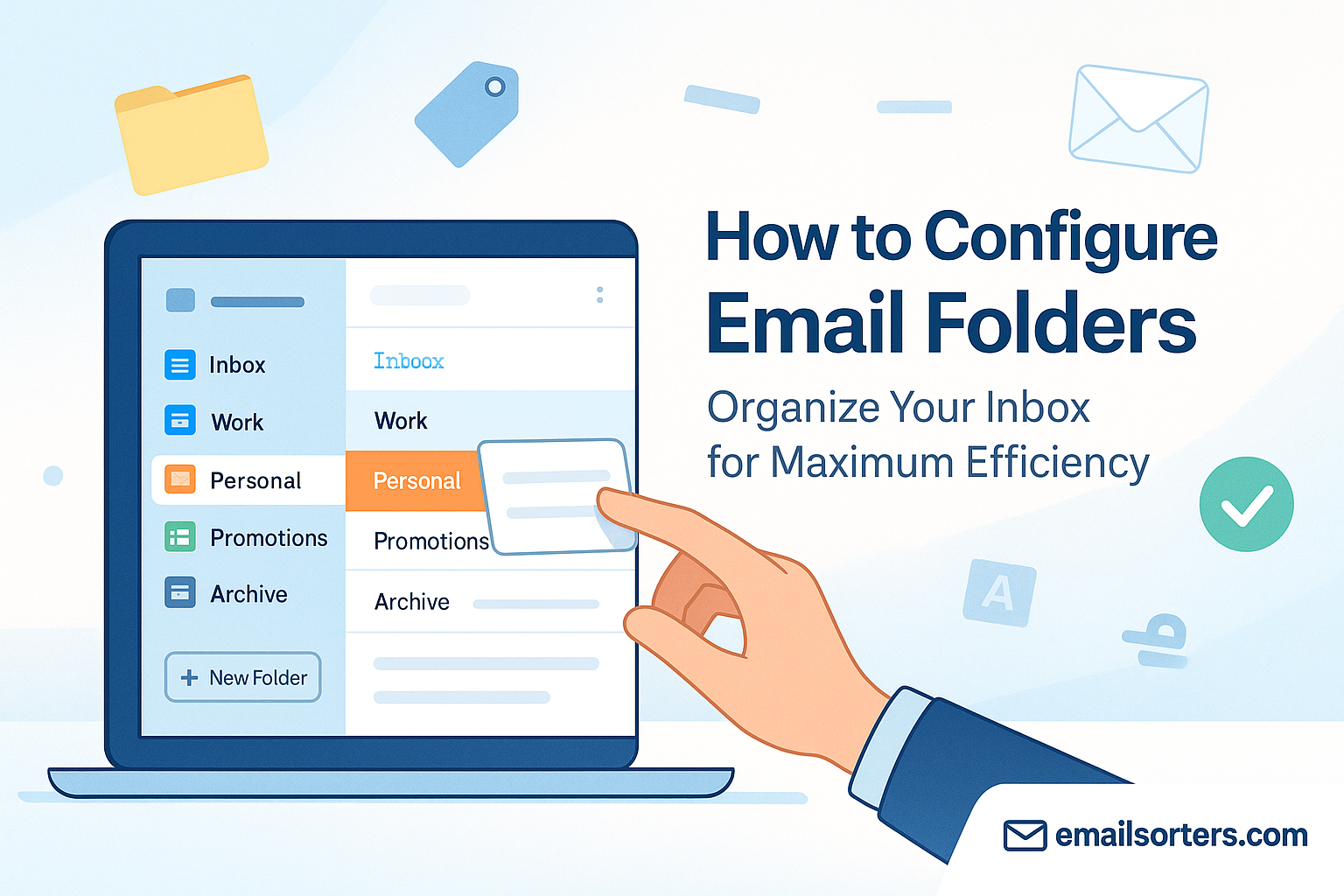
To configure folders in Outlook, you right-click on your account name in the left-hand menu and select “New Folder.” This creates a traditional folder that stores your messages.
This applies to the Outlook desktop app and Outlook.com.
- Open Outlook.
- In the folder pane on the left, right-click on your email address (or on “Inbox” if you want a sub-folder).
- Select “New Folder…”
- Type a name for your folder (e.g.,
_ACTION). - Press Enter.
- To move a message, just drag and drop it from your inbox into the new folder.
How to Configure Email Folders in Apple Mail
To configure folders in Apple Mail, you go to the “Mailbox” menu and select “New Mailbox.” You can choose to store the folder on the server (best) or on your computer.
- Open the Apple Mail app.
- In the top menu bar, click “Mailbox.”
- Select “New Mailbox…”
- A new window will pop up. For “Location,” select your email account (e.g., “iCloud” or “Gmail”). This saves the folder on the email server, so it syncs everywhere.
- Give your folder a name (e.g.,
_REFERENCE). - Click “OK.”
The Real Secret to Folder Organization: Automation (Filters & Rules)
The secret is to stop filing manually. You can configure email folders to be populated automatically. You do this by setting up “Filters” (in Gmail) or “Rules” (in Outlook) that auto-sort your mail before you even see it.
This is the key to managing your email. You should not be a human filing cabinet.
Your goal is to have 50% of your mail skip the inbox entirely.
What Is an Email Filter or Rule?
An email filter (or rule) is an automated action. It is a simple “IF/THEN” command.
- IF: A new email arrives…
- AND: The sender is
[email protected]… - THEN: Move it to the
_NEWSLETTERSfolder.
This is how you win the game.
How to Set Up a Filter in Gmail
- Open an email from the sender you want to filter.
- Click the three-dot menu (More).
- Select “Filter messages like these.”
- Gmail will pre-fill the sender’s email. Click “Create filter.”
- Now, choose your action.
- Check “Skip the Inbox (Archive it).”
- Check “Apply the label:” and choose your
_NEWSLETTERSlabel.
- Click “Create filter.”
How to Set Up a Rule in Outlook
- Right-click on an email in your inbox.
- Select “Rules” > “Create Rule…”
- A box will appear. Check the box for “From [Sender].”
- In the “Do the following” section, check “Move the item to folder:”
- Select the folder you want (e.g.,
Receipts). - Click “OK.”
What Rules Should I Create First? (The Top 5)
Start with these five automated rules. They will change your life.
- Newsletters: Create a
_NEWSLETTERSfolder. Make a rule: any email that contains the word “Unsubscribe” -> move to_NEWSLETTERS. - Receipts: Create a
Receiptsfolder. Make rules: any email from[email protected]or[email protected]-> move toReceipts. - VIP Senders: Make a rule: any email from
[email protected]-> “Star it” or “Mark as Important.” - No-Reply Mail: Make a filter for what is no-reply email addresses. Filter any mail from
noreply@...to a “To Review” folder. - Calendar Invites: Make a rule to auto-filter all “Accepted:” or “Declined:” meeting responses.
How to Manage Email Folders on Your Phone
To manage folders on your phone, you must use an IMAP connection. If you can’t see your folders, it is because your phone is not set up correctly or you need to manually “subscribe” to them in your mail settings.
This is a common frustration. “I organized my folders, but I can’t see them on my phone!”
Why Can’t I See All My Folders on My iPhone/Android?
You cannot see your folders because you are likely using POP3 or your folders are not “synced.”
- IMAP vs. POP: When you set up email on your iPhone, you must choose IMAP. IMAP syncs all folders. POP3 only downloads the inbox.
- Folder Subscriptions: In some mail clients, you must “subscribe” to folders. Go to Settings > Your Account > Folder Settings and check all the folders you want to sync.
- App Limitations: The Gmail app handles labels well. The Outlook app handles folders well. The Apple Mail app is a good “all-in-one” but can be slow to sync.
What Are Common Mistakes When Configuring Folders?
The most common mistake is creating too many folders. This is “procrastination by organization.” You feel busy filing email, but you are not doing the work.
Avoid these traps.
- The “Folder for Everything” Trap: You create a folder for every person, project, and idea. You end up with 200 folders and cannot find anything.
- Not Automating: You create 10 folders but still drag every email by hand. You will give up in a week.
- Using Folders as a To-Do List: Your inbox or
_ACTIONfolder becomes a graveyard of 50 tasks. An email is a delivery of a task, not the task itself. Use your email drafts or a real task manager. - Complex Naming:
[CLIENTS-2024-Q4-ProjectX-Urgent]. This is unhelpful. Use a flat system. - Not Having a System: You have a mix of folders.
_Action,Bob,Project X,Jokes. This is chaos. Pick one philosophy and stick to it.
What Are Email Folders on a Technical Level?
On a technical level, an email folder is a directory on a mail server. It contains the raw email files for that account. Different email servers use different formats, like mbox (one big file) or Maildir (one file per email).
This is the “under the hood” knowledge. When you create a folder in Gmail, you are not really creating a folder. You are creating a “label” tag in a massive database.
When you create a folder on a cPanel or Exchange server, you are often creating an actual directory on the server’s file system. Some systems, like the open-source Maildir format, create subdirectories for new, cur, and tmp to manage message status.
Why does this matter?
- Server-side folders (IMAP) sync across all devices.
- Client-side folders (“On My Mac” or “Personal Folders” in Outlook) live only on that one computer. If your computer dies, those emails are gone.
Rule of thumb: Always create your folders on the server (IMAP, Gmail, Outlook.com), not on your device.
What Other Tools Can Help Manage Email Organization?
Folders are just one tool. A complete system uses other tools, like alias addresses and multiple accounts, to pre-sort your life.
- Alias Addresses: An alias is a “nickname” for your email. If your email is
[email protected], you can sign up for a newsletter with[email protected]. It still comes to your inbox, but you can create a filter that auto-sends anything formyname+newsto your_NEWSLETTERSfolder. - Different Email Addresses: This is the best method. Have multiple accounts for different purposes.
- Personal: For friends and family.
- Work: For your job.
- Spam: A “junk” account for all store sign-ups.
- Specialized Accounts: You can also have a family email account for household bills or a dedicated email for children.
Your Final, Organized Email System
To configure email folders is to give every single message a home—and 90% of those homes should not be your inbox.
Your new system is simple.
- Pick Your Philosophy: Start with the 3-folder “Action” system (
_ACTION,_WAITING,_REFERENCE). - Automate Heavily: Create 5 filters for newsletters, receipts, and other noise.
- Live in Triage: Use the 2-minute rule. Do, Delete, or Defer (by archiving).
- Enjoy the Calm: Your inbox is now a place of zen.
Start small. Create one folder. _Newsletters. Set up one filter. You will be surprised at the peace of mind it brings.