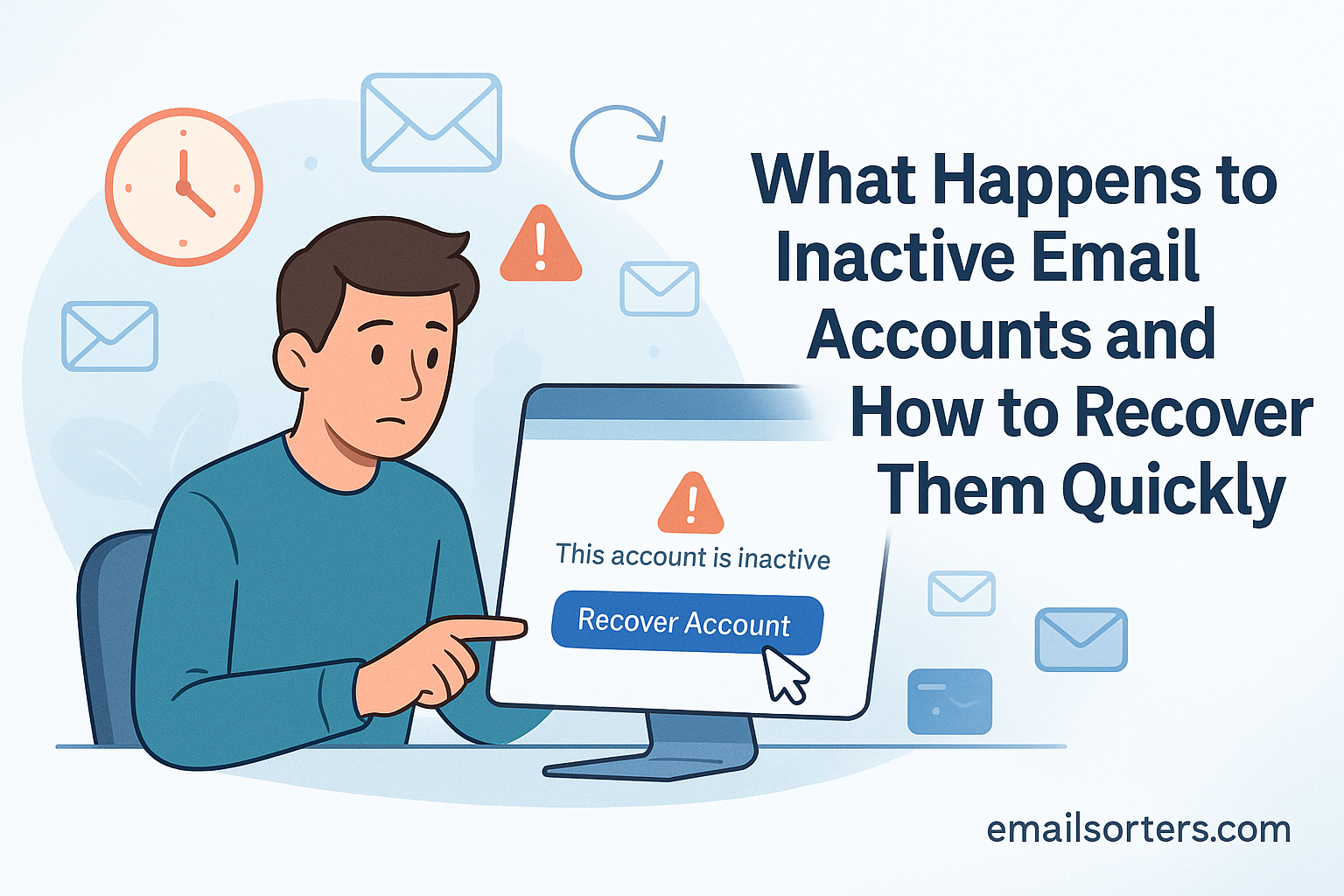
We all have them. That old email address from college. The first one you ever made. The one you used to sign up for a service 10 years ago. These digital ghosts are floating around the web, and you probably assume they will just sit there forever.
This assumption is wrong. Your inactive email accounts are not just “asleep.” They are a ticking time bomb.
Email providers are not in the business of running digital museums. They are actively purging old, abandoned accounts. When they do, it is not just your old emails that vanish. It is your data, your photos, and, most important, your digital identity.
An inactive account can be hijacked, recycled, and used to steal your identity. This guide is your wake-up call. We will cover what “inactive” means, the specific policies of Google, Microsoft, and others, and the exact steps to recover (or protect) your accounts before they are gone forever.
What Is an Inactive Email Account?
An inactive email account is one that has not been logged into or used for an extended period. This “inactivity period” is defined by the provider, not the user. Even if you receive emails, if you do not log in, the account is marked as inactive.
This is the most critical distinction. You might think, “My account is active, I get newsletters there.” But if you are not logging in, the email server sees the account as abandoned.
Activity is not just receiving mail. Activity is:
- Logging in.
- Reading or sending an email.
- Using the account to sign in to another service (e.g., using Google to log in to YouTube).
Why Do Email Providers (Like Google and Microsoft) Delete Inactive Accounts?
Providers delete inactive accounts for two main reasons: security and cost. Abandoned accounts are a massive security risk. They are also expensive, taking up server space and resources for no reason.
1. The Security Risk
This is the big one. Hackers love inactive accounts. These old, forgotten accounts are a goldmine. They often have weak, old passwords. They are not monitored. A hacker can break in, and you would never know.
They can use the account to:
- Scour your old emails for private data.
- See your contacts and send targeted spam or phishing attacks.
- Reset passwords for other services you tied to that email (your bank, your social media).
Providers delete these accounts to reduce the “attack surface” and protect their network.
2. The Cost of Storage
Storage is not free. You may have a “free” email account, but it costs the provider money to store your data. Every server costs power, maintenance, and real estate.
It makes no business sense for Google or Microsoft to pay to store billions of emails for users who have not been seen in five years. Deleting them frees up resources and saves money.
3. Recycling Addresses
Every good email address idea seems to be taken. Deleting inactive email accounts frees up those usernames, allowing new users to register them. While good for new users, this practice (which we will cover later) has its own serious risks.
How Long Does an Account Have to Be Inactive Before It’s Deleted?
The inactivity period varies by provider, but the trend is 1-2 years. Google and Microsoft have a 2-year policy. Yahoo has a 1-year policy. You must check the specific terms for each account you own.
This is the most important question. The answer determines your window for action.
| Provider | Inactivity Period | What Is Deleted? |
| Google (Gmail) | 2 years | All data (Mail, Photos, Drive, etc.) |
| Microsoft (Outlook, Hotmail) | 2 years | All data (Mail, OneDrive, etc.) |
| Yahoo | 1 year | All data. The address may be recycled. |
| AOL | 1 year | All data. The address may be recycled. |
Google’s Inactivity Policy (Gmail)
Google will delete an account after 24 months (2 years) of inactivity. “Activity” includes logging in, sending or reading mail, using Google Drive, watching a YouTube video while logged in, or using Google Search while logged in.
Before deletion, Google will send warning notices. It sends them to the inactive account itself and to any “recovery email” you have on file. This is why a valid recovery email is so important.
Microsoft’s Inactivity Policy (Outlook.com, Hotmail)
Microsoft also has a 2-year “use it or lose it” policy. You must log in to your Microsoft account at least once in a two-year period to keep it active.
If you fail to log in, Microsoft will close the account. All data in OneDrive, Outlook.com, and other associated services will be permanently deleted.
What About Student Email Accounts?
A student email account is not a personal account. It is a temporary account you are borrowing. It is governed by the school’s email domain. Most schools will delete your account within 6 to 12 months after you graduate. You will lose everything.
What Happens When an Email Account Is Marked as Inactive?
When an account is marked as inactive, it enters a deletion process. First, you get warnings (if you have a recovery email). Next, the account is suspended. Finally, all data is permanently erased.
This is a multi-stage process.
Stage 1: The Warning Period
As I mentioned, providers like Google will try to warn you. They will send emails to your recovery address. If you do not have a recovery address, you will get no warning.
Stage 2: The Deletion (What Data Is Lost?)
This is the point of no return. The deletion is permanent. All your data is wiped from the servers. This includes:
- All emails (Inbox, Sent, etc.)
- All configured email folders and your custom structure.
- All email drafts.
- All contacts (your address book).
- All associated cloud storage.
- For Google: Your Google Photos, Google Drive files, and Google Docs.
- For Microsoft: Your OneDrive files.
I want to repeat this. People often lose decades of photos because they were synced to an old, inactive Google account. The loss is total and irreversible.
Stage 3: The Address Becomes “Recycled” (Or Not)
After an account is deleted, what happens to the address itself?
- Google: Google does not recycle addresses. Once an address is deleted, it can never be used again by anyone. This is a security measure.
- Yahoo & Microsoft: They may recycle the address. This means, after a “cooling off” period, they can offer that exact address to a new user who wants to create an email account.
If someone new gets your old address, they will not see your old emails. The mailbox is empty. But they will start receiving password reset links and sensitive mail intended for you.
How Do I Recover an Inactive Email Account?
You can recover an inactive account if you act before it is permanently deleted. The method is simple: just log in. If you cannot, you must use the provider’s official recovery tool.
Let’s walk through the “how-to.”
Step 1: Just Try to Log In
This is the first and easiest step. Go to the provider’s login page. Enter your email and password.
- If you log in: Success! Your account is now “active.” You are done.
- If the password fails: Go to Step 2.
- If it says “Account does not exist”: You are too late. The account has been permanently deleted.
Step 2: Use the “Forgot Password” or Account Recovery Tool
This is your moment of truth. On the login page, click “Forgot Password?” or “Trouble signing in?”
This is now the only way to get your account back. You will be guided through an automated process. You will be asked to:
- Enter a recovery email address: The system sends a code to the recovery email you set up years ago. Do you still have access to it?
- Enter a recovery phone number: The system texts a code to your recovery phone. Is it still your number?
- Answer security questions: Some older accounts used these. “What was your first pet’s name?”
If you can provide this proof, you will be allowed to reset your password and log in.
Why Can’t I Just Call Customer Support?
For free services like Gmail, Outlook, and Yahoo, there is no customer support phone number to call.
I cannot stress this enough. You cannot call Google. The automated recovery tool is the only method. This is for security. They will not grant access to an account just because someone calls and claims to be the owner. You must prove it using the recovery tools.
What If My Account Is Permanently Deleted?
If your account is permanently deleted, the data is gone forever. You cannot get it back. Your only option is to see if you can re-register the address to prevent identity theft.
Your Data Is Gone.
Your photos, emails, and files are non-recoverable. This is a hard truth.
Your Address May Be Available.
Go to the provider’s sign-up page. Try to create a new email account using that exact same address.
- If Google, it will say “Username is taken.” (Because they do not recycle).
- If Yahoo/Microsoft, it might let you. If it does, take it. The inbox will be empty, but you have “reclaimed” the address. This stops a hacker from getting it.
How Do I Prevent My Accounts From Becoming Inactive? (Best Practices)
The best medicine is prevention. You need a simple, repeatable plan to keep your accounts “active” in the eyes of the providers.
1. The “Login Calendar”
This is my number one tip.
- Set a recurring calendar event on your phone.
- Title it: “Digital Account Check-in.”
- Set it to repeat once every 6 months.
- On that day, take 15 minutes. Log in to all your old, important accounts. This simple act resets the inactivity clock for all of them.
2. Update Your Recovery Information (Right Now)
This is the most important 5-minute task you can do today.
Log in to your important accounts (Gmail, Microsoft, etc.).
Go to the Security settings.
Check your Recovery Email and Recovery Phone Number.
Are they current? If not, update them. This is your only lifeline if you get locked out.
3. Use an Email Client
If you have several accounts, you can set up email on your iPhone or a desktop client. Adding your accounts to Apple Mail, Outlook, or Thunderbird can sometimes count as activity, as the client is “pinging” the server. But a manual web login is still the 100% guaranteed method.
4. Use Google’s Inactive Account Manager
Google has a fantastic, free tool called “Inactive Account Manager.”
You can tell Google what to do if your account becomes inactive.
- Set a timeout: (e.g., 18 months).
- Choose who to notify: You can add a trusted friend or family member.
- Decide what to share: You can give that person access to just your Photos or Drive.
- Decide to delete: You can tell Google to auto-delete everything.This is a powerful “digital will” and I recommend everyone set it up.
5. Consolidate Your Multiple Accounts
Stop making new accounts for everything. It is better to have one or two well-managed different email addresses than 10 forgotten ones.
If you need different addresses for different purposes, use alias addresses instead. These are “nicknames” that all feed into your one main, active inbox.
What Are the Security Risks of an Abandoned, Inactive Account?
An abandoned, inactive account is a “ghost” that can be hijacked. Hackers can use it to reset your passwords on other, more important sites.
This is the “chain of failure” I have seen happen.
- A hacker finds your old, inactive email (e.g.,
[email protected]) from a 2012 website breach. - They go to your Facebook, your bank, or your Amazon account. They type in
[email protected]and click “Forgot Password.” - The reset link is sent to your old, inactive Hotmail account.
- You do not see it. But the hacker tries to register
[email protected]. Because it is inactive, Microsoft lets them. - The hacker now owns your old email address. They receive the password reset link.
- They have just taken over your bank, your Amazon, your life.
They can also use your old contacts, your CC and BCC lists, and your old emails to run scams on your family. They might find info on your family email account or email for children and target them.
Your Digital Life Is Your Responsibility
Your inactive email accounts are not in storage. They are on a timer. The old digital world of “set it and forget it” is over. We have had email for over 50 years (a fact we cover in the fiftieth anniversary of email), and these policies are the new reality.
Do not let your digital past become a security risk. Today, right now:
- Log in to your 3-4 most important accounts.
- Update your recovery phone and email.
- Set that 6-month calendar reminder.
It is the best 15 minutes you will ever spend on your digital security.