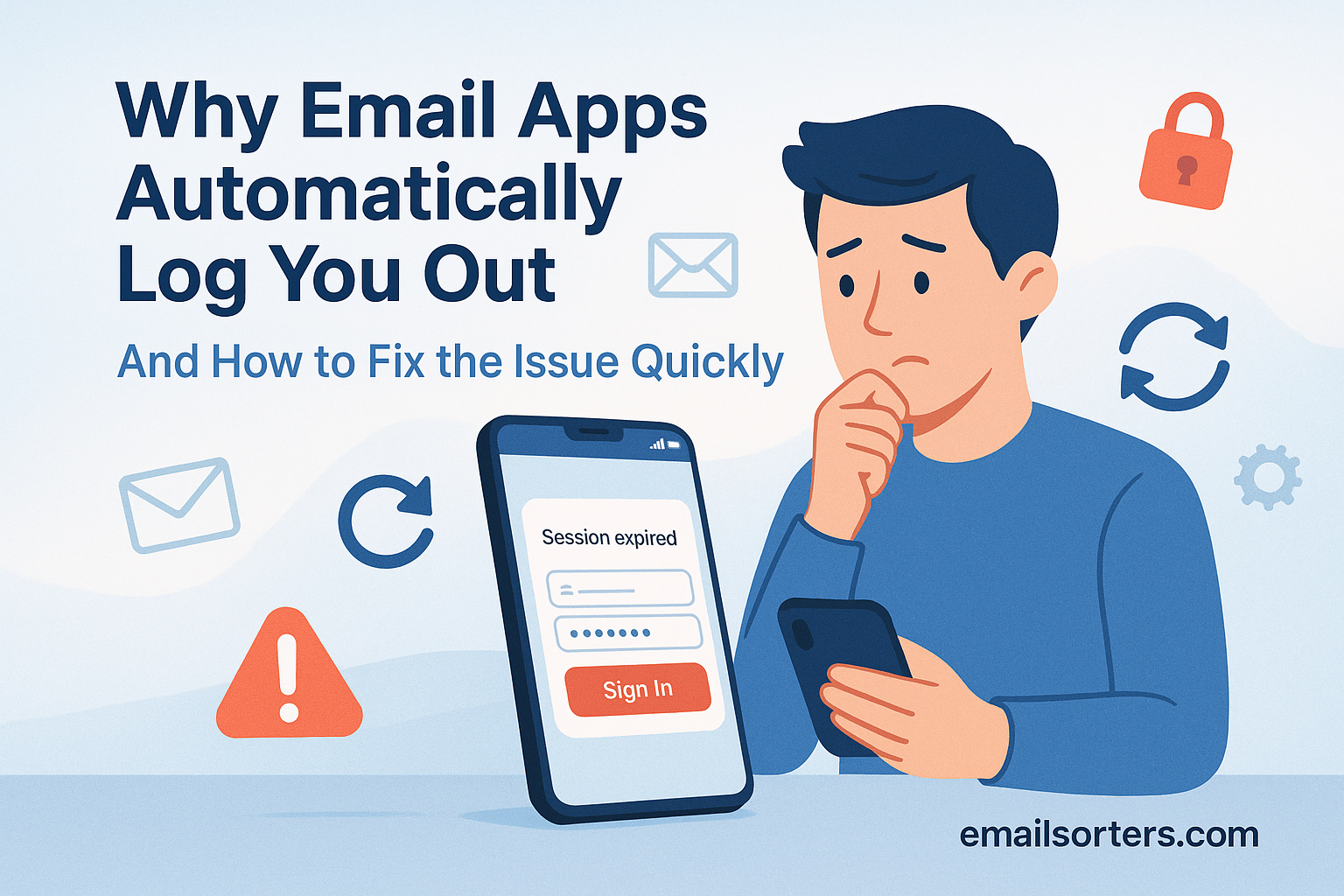
It is one of the most common frustrations in modern life. You open your email app, ready to work, only to be hit with a login screen. You sigh, type in your password (again), and wonder why this keeps happening. An automatic logout can feel like your app is broken or forgetting you.
Here is the truth: it is not a bug. It is a security feature.
This “problem” is almost always an intentional, non-negotiable security policy. It is designed to protect you. Your app is not broken; it is being obedient.
This guide will explain, in plain English, why this happens, what is going on behind the scenes, and what “fixes” you can apply to manage it. We will cover everything from security tokens to corporate policies so you can finally understand, and control, your login.
What Does “Automatic Logout” Actually Mean?
An automatic logout, also known as a “session timeout,” is a security feature that automatically ends your active connection to a service. After a set period of inactivity, the email server invalidates your “key,” forcing you to re-enter your password.
What Is an Email “Session”?
To understand a logout, you first have to understand a login.
When you log in to your email, you are not just “opening” your inbox. You are creating a “session.” Think of it as a digital key. You give the server your password (the master key), and it gives you back a temporary “session key” (also called a token).
This token is what your app shows the server every time it fetches new mail. It is a way of saying, “I’m still the same person who logged in 10 minutes ago.”
An automatic logout is simply the server deciding that your temporary key has expired.
Why Does My Email App Keep Logging Me Out? (The Top Reasons)
Your email app keeps logging you out because your provider’s server (Google, Microsoft, or your company) is ending your session. This is a deliberate security policy to prevent unauthorized access if your device is lost, stolen, or left unattended.
Let’s break down the specific reasons why that session key expires.
1. Session Token Expiration (The Most Common Cause)
This is the #1 reason. Your temporary “key” has an expiration date.
Most email providers set this to 14 days, 30 days, or 90 days. This is a standard security practice. It means that even if a hacker did steal your session token, it would be useless after a few weeks.
You cannot “fix” this. It is a server-side rule. You just have to re-enter your password when the time comes.
2. Corporate Security Policies (The “Admin” Override)
If this is happening to your work, school, or student email account, you can be 100% sure it is an intentional policy. Your company’s IT administrator has set a very short session limit.
Why? If you lose your company phone, the IT department wants to ensure that a thief can only access your data for a few hours, not forever. This is common for any email on a custom email domain.
3. A Password Change (The “Re-Auth” Trigger)
Did you change your password recently? If you change your password on any device, the server immediately invalidates all other session keys.
This is a critical security feature. If a hacker gets your password and changes it, this feature logs you out, too, alerting you that something is wrong. But more often, you change your password on your laptop, and then your phone and tablet all ask you to log in again.
4. Suspicious Activity Detected
Google and Microsoft are very good at spotting unusual behavior. If you log in from a new device, a different country, or at an odd time, the system may panic.
It will send you a “Was this you?” alert. As a precaution, it may invalidate your other sessions, forcing you to re-authenticate on all your devices to prove you are you.
5. You Are Using a Public or Shared Device
This one is obvious, but it is important. If you are at a library, hotel, or using a friend’s computer, the browser is set to “guest” or “incognito” mode.
These modes are designed to not save any session keys. The automatic logout is instant. The moment you close the browser tab, your session is destroyed. This is exactly what you want on a public computer.
Is This an App Problem or a Server Problem?
It is almost always a server problem (or policy). Your app is just the messenger. When your app (the client) tries to check for mail, the server rejects the “session key.” The app then does the only thing it can: it shows you the login screen.
Think of this exchange:
- Your App: “Hi, server! Here is my token. Any new mail for me?”
- Email Server: “Sorry, I don’t recognize this token. It’s expired.”
- Your App: “Okay. I can’t get any mail.”
- Your App (to you): “Please log in.”
Sometimes, the app can be the problem, but it is rare. We will cover that in troubleshooting.
How to Stop (or Manage) Automatic Logouts
While you cannot stop a corporate security policy, you can take steps to make logouts less frequent for your personal accounts. The goal is to ensure your app is using a “persistent” token, not a temporary one.
1. Check the “Keep Me Logged In” Box
This is the simplest fix. When you log in on a web browser, there is almost always a checkbox that says “Keep me logged in” or “Remember me.”
- What it does: This tells the server to issue a “persistent” token, not a “session” token. This token has a much longer expiration date (e.g., 90 days) and is saved in your browser’s “cookies.”
- What it does NOT do: It does not save your password in the browser. It saves the key.
2. Use a Dedicated, Modern App
The biggest mistake I see is people using their phone’s web browser to check email. This is slow, clunky, and browsers are designed to purge “cookies” and “sessions” to save space.
You should always use a dedicated, modern email app.
- The Gmail app
- The Outlook app
- The Apple Mail app
These apps are designed specifically to manage login tokens securely. They store the token in your phone’s secure keychain, which is the safest place for it. When you set up email on your iPhone, the system is built to handle this.
3. Re-Authenticate Your Account (The “Hard Reset”)
Sometimes, your app gets “stuck.” It might be holding onto a corrupt or old token and does not know how to ask for a new one. The fix is to perform a “hard reset” of the account.
You are not deleting your email. You are just removing the account from your phone.
On iPhone:
- Go to Settings > Mail > Accounts.
- Tap the account that is giving you trouble.
- Tap “Delete Account.” (This only deletes it from your phone).
- Go back to Accounts > Add Account and log in again.
On Android:
- Go to Settings > Accounts and backup > Manage accounts.
- Tap the problematic account.
- Tap “Remove account.”
- Go back and “Add account” to log in fresh.
This 5-minute fix solves 80% of actual app-related login issues.
4. Check Your Security Settings
If you have very high-security settings on your Google or Microsoft account, you might be the one causing the logouts.
- Go to your Google/Microsoft account’s security settings.
- Look for “Session management” or “Devices.”
- You may see a setting like “Log out of all accounts after X days” or “Re-auth on new device.”
- If you have this set aggressively, you are your own IT admin.
What If My App Is Actually Broken? (Troubleshooting)
What if you are logged out every single time you open the app? This is not a session timeout. This is a broken app. This is not a server policy; this is a client-side bug.
How to Fix a Corrupt App Cache
Sometimes, the app’s “cache” (its temporary memory) is corrupt.
- On iPhone: The easiest way is to “Offload” the app. Go to Settings > General > iPhone Storage > [Your Mail App] > Offload App. This keeps your data but deletes the app. Then, tap to reinstall it.
- On Android: Go to Settings > Apps > [Your Mail App] > Storage > Clear Cache. Do not tap “Clear Data” unless you are ready to log in again. Start with the cache.
How to Reinstall the App
The final “nuke” option. Delete the app from your phone entirely. Go to the app store. Re-download it. This ensures you have the absolute latest, uncorrupted version. This is different from just “adding” an account; this is a full reset. You will have to create an email account setup from scratch (by logging in).
What Is NOT an Automatic Logout? (Common Look-Alikes)
It is easy to see an error and think it is a “logout.” But different errors have different causes.
| Error Message | What It Really Means |
| “Cannot Connect to Server” | This is a network problem. Your phone has no Wi-Fi or cellular data. It is not a logout. |
| “Incorrect Password” | You are typing the wrong password. The server is rejecting you. |
| Mailer-Daemon | This is an email delivery failure. You sent an email, and it “bounced.” It has nothing to do with your login. |
| “Sync Error” | Your app is logged in, but it’s failing to sync new mail. This is often a temporary server glitch. |
When Is Automatic Logout a GOOD Thing?
An automatic logout is a critical security feature on any device you do not 100% control.
1. On Public or Shared Computers
This is the big one. If you log in to your email at a hotel, library, or on a friend’s laptop, you want the automatic logout. When you close that browser, you are relying on the session being destroyed. If it does not, the next person can access your entire life.
2. For Email for Children
When you set up an email for children, you want to teach them good “digital hygiene.” Logging out is part of that. It reinforces that access is not permanent and that you should close the door when you are done.
3. For a Family Email Account
If you share a family email account on a tablet, you want it to log out. Otherwise, you may accidentally send an email from the shared account when you meant to send it from your personal one.
4. For Inactive Email Accounts
When you are done with an account, you should log out on all devices. This is the first step to “decommissioning” that address.
How to Manage Logins for Multiple Accounts
If you manage multiple accounts, frequent logouts can be a nightmare. The solution is not to stop the logouts, but to make re-logging in painless.
- Use a Password Manager: Tools like 1Password, Bitwarden, or Apple Keychain are essential. A 30-day logout is not a problem when your password manager can fill in your credentials in one second.
- Use Browser Profiles: If you use a browser, use profiles. Have a “Work” profile and a “Personal” profile. This keeps the sessions and tokens for your different email addresses completely separate.
- Use Alias Addresses: This is a bit different, but an alias address is a “nickname” for your email. This reduces the number of accounts you need to log in to.
- Organize Your Accounts: Once you are logged in, make sure you can find everything. Configure email folders to keep things clean and use your email drafts folder as a staging area.
The Future of Logins: Passkeys
The entire concept of passwords and logouts is outdated. The future, which is already here, is “passkeys.”
A passkey uses your device’s biometrics (Face ID, fingerprint) to create a unique, unphishable key. You do not have a password. To log in, you just look at your phone. This is more secure and less annoying. It may make the automatic logout a thing of the past.
Your App Is Not Betraying You
An automatic logout is not a sign of a broken app. It is a sign of a secure app. It is a digital seatbelt. It might be annoying, but it is there to save you in a crash.
By understanding why it happens, you can see it not as a “fix” but as a “management” issue. Use a dedicated app, use a password manager, and reset the account if it gets stuck. This will give you the safest, sanest email experience.