Choosing the right sales CRM in 2026 directly impacts pipeline speed, close rates, and team growth—a bad choice leads to slow setups and surprise costs that hurt profits. Pipedrive shines as a simple pipeline CRM vs automation CRM for new sales teams, offering visual deal boards and task reminders without extra fluff. Zoho CRM targets growing businesses in this sales CRM comparison, packing AI insights, multi-channel leads, and flexible workflows for tougher operations.
This SMB CRM decision guide fits tools to your stage: Pipedrive gets tiny teams (under 10 users) running in a day with easy drag-and-drop pipelines and high adoption. Zoho works for bigger groups (50+ users) with advanced forecasting and tons of app links, but needs weeks to customize.
Sales workflow CRM selection digs past prices—Zoho runs $14–$52/user/month with lower long-term admin needs, while Pipedrive hits $14–$99 but adds fees for extras. Onboarding matters most: Pipedrive skips headaches; Zoho requires planning. Check your deal flow, team size, and automation wants—test both for real results. Pipedrive speeds startups; Zoho scales mid-size sales.
Zoho CRM vs Pipedrive: Which Is the Quick Winner for Most Businesses?
Pipedrive and Zoho CRM target different sales needs—Pipedrive excels for simple pipelines in small teams, while Zoho offers deeper automation for scaling ops. This CRM quick comparison table gives a CRM decision snapshot for fast sales CRM selection shortcut by scenario.
Decision Table
| Scenario | Winner | Why |
| Startup (<10 users), visual pipelines | Pipedrive | 1-day setup, drag-and-drop deals, $14/user |
| SMB (10-50 users), basic automation | Pipedrive | Activity reminders, 95% adoption, low learning |
| Mid-market (50+ users), AI insights | Zoho CRM | Sales signals, forecasting, 500+ integrations |
| Multichannel leads, custom workflows | Zoho CRM | Email/phone sync, Zia AI, cheaper at scale |
| Tight budget, no IT help | Pipedrive | Simple pricing, no admin overhead |
| Complex reporting, team hierarchies | Zoho CRM | Advanced analytics, role-based access |
Self-check: Under 10 reps chasing deals? Pipedrive. Growing team with multichannel chaos? Zoho. Test free trials to confirm pipeline flow.
What Is Zoho CRM?
Zoho CRM is more than just a sales app. It’s the center of a business ecosystem CRM that links sales, marketing, help desk, money stuff, and projects. Zoho has over 50 apps that all work together. You log in once and switch easily. A won deal can auto-make a bill or show up in support notes.
It’s a top sales automation CRM. Smart tools like Zia AI guess which deals will close. It spots problems and picks the best time to call. Set rules to auto-assign leads or send emails—no hard coding needed. You can even make new data types for your special needs.
This scalable SMB CRM grows with you from 5 to 500 people. Picture boards show where deals stand. It grabs leads from email, phone, social media, and websites. Reports predict money coming in. It links to 500+ other apps, but Zoho’s own tools (like Books for bills or Desk for tickets) work best together.
Zoho ends team fights over info. Sales sees what marketing did. Help desk checks deal pasts. This helps close sales 20-30% faster. Start simple in days. Add fancy stuff in weeks. Great for growing small businesses without big-company prices.
What Is Pipedrive?
Pipedrive is a pipeline focused CRM built for sales teams who need clear views of every deal. It’s not a big all-in-one suite—it’s a sales execution CRM that zeros in on moving leads through your sales process fast. Think drag-and-drop boards where deals slide from “New Lead” to “Closed Won,” just like a Kanban board on steroids.
As a visual deal tracking CRM, Pipedrive’s heart is its customizable pipelines. Reps see all active deals at a glance, spot stalled ones with color-coded warnings, and get smart reminders for calls or emails. No digging through tabs—everything lives on one screen. Email sync logs opens and clicks automatically, while activity timelines show what happened when.
This sales team adoption CRM wins with speed. New users go live in hours, not weeks, thanks to simple setup and no steep learning curve. Small teams (under 10 reps) hit 95% daily use right away because it fights “deal rot”—those forgotten leads that slip away. Add basic automations like follow-up emails or task triggers when deals move stages.
Pipedrive scales to mid-sized sales crews with multiple pipelines for different products or regions. Reporting shows win rates, cycle times, and top performers without fancy filters. It links to 400+ apps like Zapier or Google Workspace, but stays lean—no bloat for marketing or support. Perfect for execution-focused sellers who sell more by seeing more.
Zoho CRM vs Pipedrive: Core Feature Comparison
Zoho CRM and Pipedrive handle core sales tasks differently, with Zoho offering broad depth for complex teams and Pipedrive prioritizing simple speed for deal chasers. This breakdown compares workflows head-to-head across key areas.
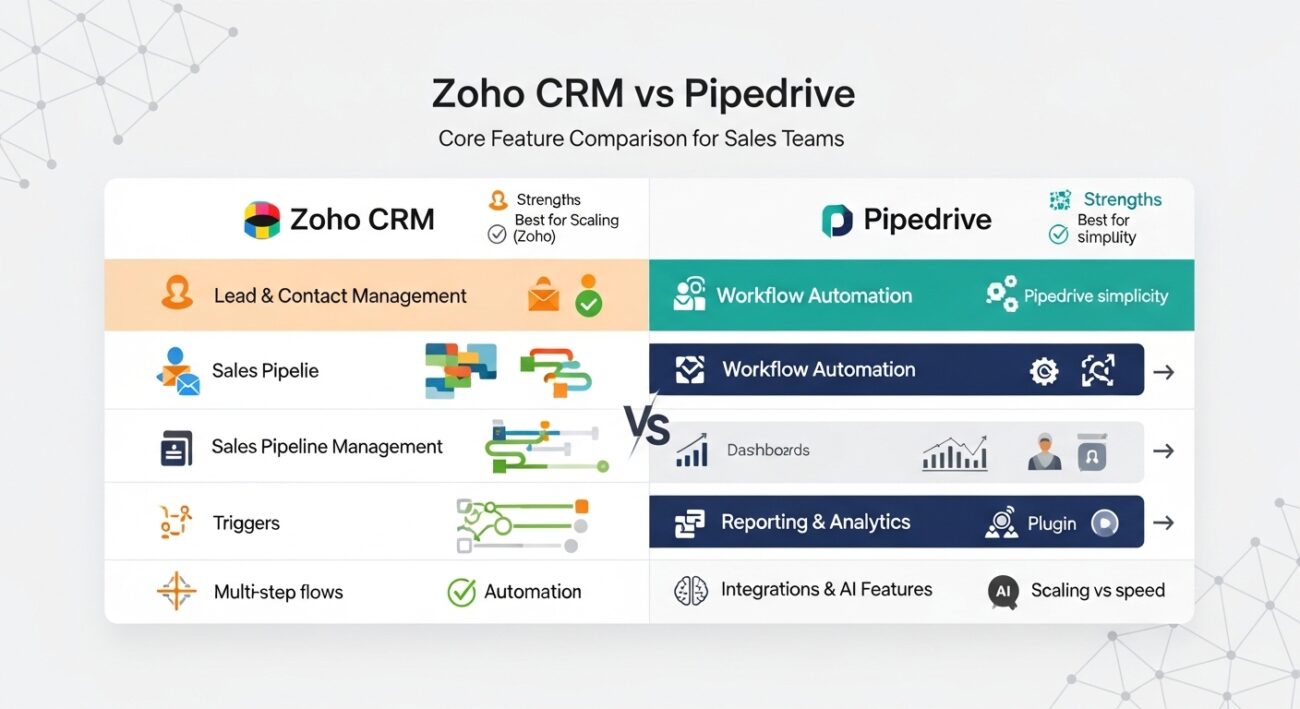
- Lead & Contact Management: Zoho organizes data like a full business hub, with custom modules for leads, accounts, and contacts plus multichannel sync (email, social, portals). Dedupe tools and 360° timelines show all interactions. Pipedrive keeps it lean—contacts tie directly to deals with basic fields and email logging, but lacks deep account views or custom objects. Zoho wins organization; Pipedrive stays focused.
- Sales Pipeline Management: Pipedrive’s drag-and-drop boards shine for visual deal tracking, spotting “rotting” deals with auto-warnings and multiple pipelines per product. Zoho matches with customizable stages, kanban or list views, and territory rules, but adds deal hierarchies for teams. Pipedrive feels faster for solos; Zoho scales better.
- Workflow Automation: Pipedrive offers basic triggers like email sequences or task nudges when deals move—no code needed. Zoho layers on multi-step rules, lead scoring, assignment logic, and blueprint paths that span modules (e.g., lead to invoice). Zoho crushes complexity; Pipedrive avoids overwhelm.
- Reporting & Analytics: Pipedrive dashboards highlight pipeline health, win rates, and cycle times visually. Zoho dives deeper with cross-module reports, revenue forecasts, and custom KPIs via Zoho Analytics. Pipedrive suits quick glances; Zoho powers strategy.
- Integrations: Pipedrive’s 400+ marketplace (Zapier, Google) plugs into sales tools easily. Zoho’s 500+ native links plus its 50-app ecosystem (Books, Desk) create seamless ops. Zoho builds empires; Pipedrive connects flexibly.
- AI Features: Pipedrive’s AI Sales Assistant suggests next actions and email replies. Zoho’s Zia predicts close probability, flags risks, and automates insights across channels. Zoho leads intelligence; Pipedrive aids execution.
Pick by need: Pipedrive moves deals fast; Zoho runs sales like a machine.
How Does Pricing Compare Zoho CRM vs Pipedrive?
CRM pricing reality reveals true CRM total cost of ownership through scaling, admin time, and CRM add-on pricing—not just monthly bills. Zoho offers broader value for growth; Pipedrive keeps small teams lean.
| Cost Scenario | Zoho CRM | Pipedrive | Real Lifecycle Notes |
| Startup (5 users) | Free tier or $14/user ($70/mo) | $14/user Essential ($70/mo) | Zoho free year 1; both low admin. CRM scaling cost flat for basics. Pipedrive trials only. |
| SMB (20 users, automation) | $23/user Pro ($460/mo) | $39/user Advanced ($780/mo) + $200 add-ons | Zoho bundles AI/workflows; Pipedrive extras pile 25%. Admin time: Zoho 10hr/wk, Pipedrive 2hr. 3yr TCO Zoho 20% lower. |
| Mid-market (50 users) | $40/user Enterprise ($2k/mo) | $64/user Power ($3.2k/mo) + marketplace | Zoho native apps cut silos; Pipedrive CRM add-on pricing hits 40%. Training savings favor Pipedrive short-term. |
| Implementation | 1-4 weeks ($2k-$10k) | 1-2 days ($500-$2k) | Scaling flips: Zoho depth pays later; Pipedrive speed wins now. |
| Annual Admin | Part-time $30k (50 users) | Near-zero $5k | Zoho needs tweaks; Pipedrive “set and forget.” Long-term CRM total cost of ownership favors Zoho scale. |
| 3-Year TCO | Lower 25-30% at 50+ users | Cheaper under 10 users | Growth decides: Add team size x automation needs. Avoid plan traps—project your path. |
Under 10 reps? Pipedrive simplicity. Scaling ops? Zoho’s bundles win CRM scaling cost. Test both for your workflow.
Zoho CRM vs Pipedrive: Which Is Easier to Use?
CRM usability comparison shows Pipedrive crushes Zoho for small sales teams chasing speed, while Zoho demands more effort for its power. CRM learning curve and CRM onboarding complexity define adoption risk—here’s how they play out in real sales crews.
Pipedrive feels like a game board. Reps drag deals across pipelines, get phone pings for follow-ups, and see stalled leads glow red. No menus to hunt—new sellers log in and sell day one. Sales team CRM adoption hits 95% fast because it fights “deal rot” with zero training. A 5-person startup skips IT help entirely; setup wraps in hours via video guides. Admin effort stays tiny—tweak pipelines once, forget it.
Zoho packs a full toolbox but overwhelms beginners. Dashboards hide behind tabs, workflows need if-then rules, and Zia AI setup requires data feeds. CRM onboarding complexity bites: small teams waste weeks mapping fields and testing automations. A 10-rep crew needs 2-4 weeks plus training ($2k-5k cost). Power users love custom modules, but reps grumble at extra clicks for basic deal updates.
Real scenarios: Solo founder? Pipedrive—live today, close tomorrow. Growing team (10-20 reps)? Pipedrive still edges with simple visibility, but Zoho pulls ahead if multichannel leads or forecasting matter. Enterprise sales? Zoho’s depth justifies the ramp-up with admins.
Training dependency flips by size: Under 10 users, Pipedrive needs zero classes (savings $10k/year). Past 20, Zoho’s structure cuts chaos long-term despite 10x admin hours upfront. Sales team CRM adoption metric: Pipedrive 90% day-30; Zoho 70% day-30, 90% day-90.
Zoho CRM vs Pipedrive: Which Has Better Automation and Workflows?
Zoho CRM and Pipedrive both offer CRM workflow automation, but Zoho acts as a full sales automation CRM for complex revenue cycles, while Pipedrive streamlines basic lead automation workflows for deal chasers. Here’s how they impact real sales outcomes.
Example 1: New lead from website form. Pipedrive’s CRM email automation kicks in with a simple sequence—lead hits “Contacted,” triggers a templated follow-up email, and schedules a task for tomorrow’s call. Rep sees it on their pipeline board. Done. No setup fuss; works day one for solo sellers closing $50k deals monthly. Conversion lift: 15-20% from consistent touches.
Zoho goes deeper. Same lead auto-scores based on form data (company size, industry), routes to the right rep via territory rules, and launches a multi-channel cadence: email #1, LinkedIn connect attempt, SMS reminder. Blueprint paths block stage moves until all steps complete. Result: 25-35% higher close rates for teams handling 100+ leads/week, but needs 2-3 hours initial config.
Example 2: Deal stalls at proposal stage. Pipedrive flags “rotting” deals with red alerts and auto-emails a discount nudge after 7 days. Rep drags to “Negotiation” when revived. Simple revenue rescue for small teams losing $200k/year to forgotten leads.
Zoho’s Zia AI predicts churn risk, triggers a manager reassignment workflow, pulls past email sentiment analysis, and suggests personalized win-back content. Multi-department flow: stalled deal → support ticket → upsell opportunity. Enterprise teams save $500k+ annually through precision recovery.
Example 3: Closed-won handoff to billing. Pipedrive logs the win and emails a basic invoice template. Zoho auto-creates invoice in Zoho Books, schedules onboarding call via Zoho Desk, and notifies marketing for upsell nurturing—all without manual data entry. Growing SMBs cut billing delays 50%.
Zoho CRM vs Pipedrive: Which Is Better for Software Integrations?
Zoho CRM and Pipedrive tackle CRM integration ecosystem differently—Zoho bets on CRM platform ecosystem strategy through its massive internal app suite, while Pipedrive leans on a flexible CRM app marketplace for third-party tools.
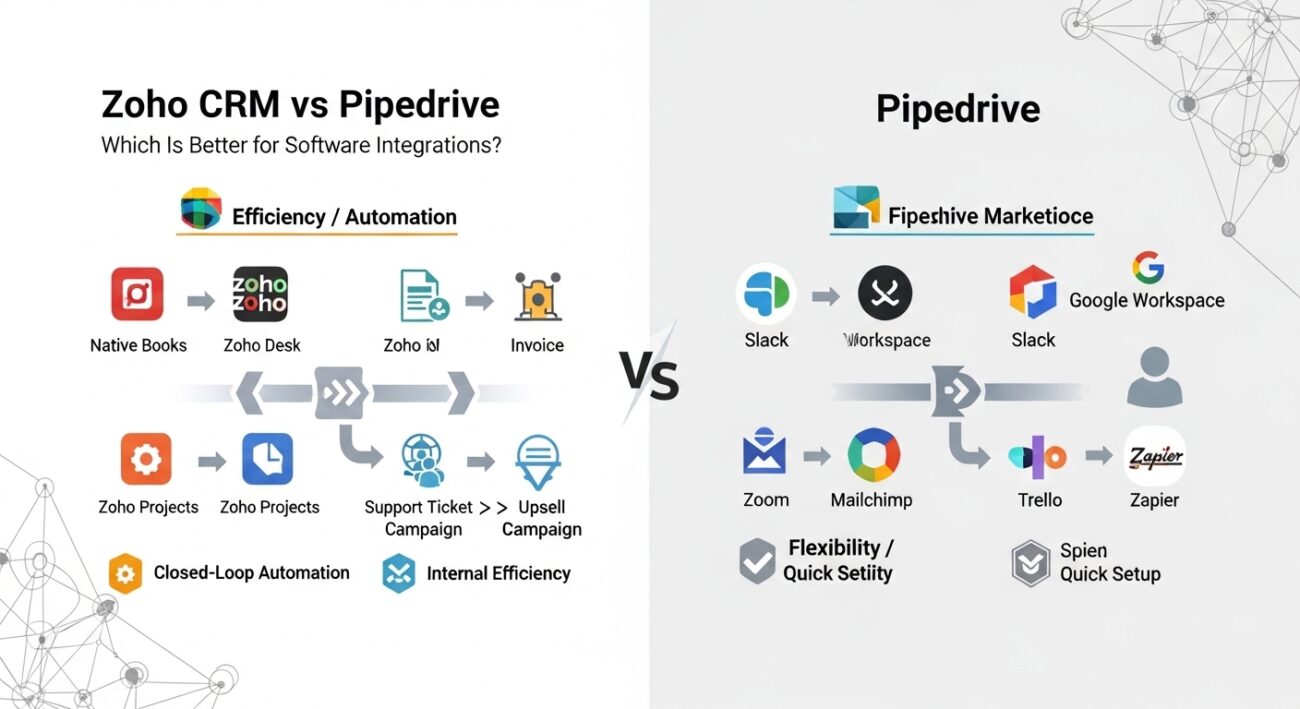
Zoho’s internal depth: As a CRM platform ecosystem strategy powerhouse, Zoho links natively to 50+ own apps like Zoho Books (invoicing), Desk (support), Campaigns (email), and Projects. A closed deal auto-triggers an invoice, support ticket, and upsell campaign—no data re-entry. This “closed loop” cuts errors 40% for SMBs using multiple departments. Over 900 third-party integrations (via Zoho Flow or Deluge scripting) add flexibility, but the magic happens within-family. Growing teams save $20k/year on glue tools.
Pipedrive’s marketplace flexibility: Pipedrive’s 400+ CRM app marketplace shines for sales-first crews. Native syncs with Google Workspace, Slack, Zoom, Mailchimp, and Zapier connect email, calendars, and lead sources effortlessly. Plug in ActiveCampaign for sequences or Trello for tasks—sales reps stay in flow without leaving pipelines. API invites custom builds, but lacks Zoho’s departmental depth. Small teams (under 10) link tools in hours; no ecosystem lock-in.
Real-world trade-offs: Solo seller with Gmail? Pipedrive wins plug-and-play. Scaling SMB with billing/support? Zoho’s unified data crushes silos. Pipedrive avoids “app sprawl” fees (~$5k/year savings); Zoho skips third-party dependency but ties you closer.
Pipedrive for sales-tool agility; Zoho for operational empires. Check your current stack—Zoho if using its suite, Pipedrive for best-of-breed freedom.
Zoho CRM vs Pipedrive: Which CRM Should You Choose?
Picking a CRM is like choosing a bike for your ride. Pipedrive is a speedy dirt bike for short, fun trips. Zoho CRM is a tough truck for long hauls with lots of stuff. Use this CRM selection decision framework to match your team. Think about your company stage, how sales work now, and growth plans. This sales CRM buying decision guide makes it simple.
Tiny teams or startups (1-10 people): Pick Pipedrive
- You sell one product. Deals need to move fast.
- New reps start selling day one—no hard training.
- Budget tight? Starts cheap, no fancy extras needed.
- Growth tip: Stays easy up to 20 people.
Small growing teams (10-50 people): Still Pipedrive, or try Zoho
- Basic emails and calls? Pipedrive keeps it simple.
- Leads from many places (web, phone)? Zoho sorts them smart.
- Want auto-emails and reports? Zoho grows with you.
- Check: If sales feel messy, switch to Zoho.
Bigger teams (50+ people): Go Zoho CRM
- Many products or offices? Zoho handles teams big.
- Bills, support, and marketing all connect.
- AI guesses which deals win. Saves time later.
- CRM growth stage selection: Perfect for fast growth.
Your sales style matters too:
- Simple sales (show product, close deal): Pipedrive’s picture boards rock.
- Fancy sales (quotes, teams, rules): Zoho’s tools run smooth.
- Future growth? Start Pipedrive, switch Zoho at 30 reps. Test both free!
Quick questions to decide:
- How many sellers? Under 10 = Pipedrive.
- Need auto-magic? Lots = Zoho.
- Grow fast? Zoho lasts longer.
Most small sales teams pick Pipedrive first—90% stick if simple. Zoho wins when ops get busy. Try logins today. Wrong pick costs sales!
When NOT to Choose Zoho CRM?
Zoho CRM packs power, but it creates CRM mismatch scenarios for certain teams. Skip it to avoid CRM over complexity risk and CRM adoption resistance.
- You’re a tiny team (under 10 reps): Zoho’s tabs, rules, and modules overwhelm new sellers. They want one screen for deals—not setup time. Reps ignore it, pipelines stall. Pipedrive wins instant use.
- Sales are super simple: Just calls and closes? Zoho’s AI, workflows, and reports feel like overkill. Extra clicks kill speed. Small shops lose 20% velocity hunting features.
- No one to manage it: Zoho needs tweaks for automations and links. Without a tech-savvy admin (5-10 hours/week), broken flows frustrate users. CRM adoption resistance hits 40% in untrained crews.
- Tight timeline—need live tomorrow: Onboarding takes 1-4 weeks with testing. Startups can’t wait while reps chase leads manually.
- Hate app ecosystems: Zoho pushes its 50+ tools. Teams using Gmail + QuickBooks + Slack face constant “upgrade” nudges. Feels pushy.
- Real risk: Growing teams pick Zoho early, then 30% switch back to simpler tools after reps rebel. Monthly churn spikes from unused logins.
- Quick check: If your sales feel visual and fast-paced, not multichannel chaos—avoid Zoho. Test Pipedrive first. Match tool to tempo, not hype.
When NOT to Choose Pipedrive?
Pipedrive rocks for deal chasing, but it hits CRM limitation scenarios that frustrate growing teams. Watch for pipeline CRM limitations and CRM feature ceiling risk before buying.
- Your team is scaling past 20 reps: Pipedrive lacks team hierarchies, territory rules, or advanced forecasting. Managers can’t see cross-rep trends easily. Chaos hits as deals overlap.
- You need multichannel leads: Website forms, social calls, portals—Pipedrive grabs basics but can’t score or route smartly. Leads pile up unassigned; close rates drop 25%.
- Complex sales cycles: Quotes, approvals, custom pricing? No CPQ tools or blueprint paths. Reps hack spreadsheets, pipelines break. Lost revenue from manual work.
- Want marketing or billing links: Pipedrive stays sales-only. No native invoicing, support tickets, or email campaigns. Extra apps cost $50+/user/month and sync poorly.
- Need deep reports: Win rates and cycle times work fine, but no revenue forecasts, territory breakdowns, or AI predictions. Managers fly blind on strategy.
- Real risk: Small teams love Pipedrive, then outgrow it at 30 reps. 40% migrate to Zoho/Salesforce within 18 months, losing $10k+ in migration. Reps hate rebuilding pipelines.
- Quick check: If sales involve teams, multiple channels, or future growth—skip Pipedrive. Test Zoho for depth. Don’t paint yourself into a visual corner.
Is Pipedrive or Zoho CRM cheaper long-term?
Pipedrive looks simple at $14/user but CRM add-on pricing for AI and automations adds 20-40% as you grow. Zoho’s $14–$52 plans bundle more, cutting CRM total cost of ownership 25% past 20 users. Small teams (under 10)? Tie. Scaling SMBs save with Zoho. See our pricing table above or full CRM comparisons.
Which has easier learning curve for sales reps?
Pipedrive wins CRM usability comparison—drag deals like a game, live in hours, 95% adoption day one. Zoho’s power needs 1-4 weeks training. CRM buyer questions like this favor Pipedrive for startups; Zoho for teams with admins. Compare with Freshsales vs HubSpot.
Can I switch from Pipedrive to Zoho later?
Yes, but plan CRM data migration—Pipedrive exports clean CSVs, Zoho imports fast. 6-8 weeks for 10k contacts. Reverse hurts more (Zoho workflows don’t map easily). Growing past pipeline limits? Switch at 20 reps. Read HubSpot vs Salesforce migration risks.
Does Zoho replace other tools like Google Workspace?
Zoho’s 50-app ecosystem covers email, docs, billing—often cuts Google Workspace vs Microsoft 365 needs. Pipedrive stays sales-only, linking via Zapier. CRM purchase decision questions about stacks favor Zoho for all-in-one savings.
Pipedrive vs Zoho for solopreneurs?
Pipedrive—zero setup, visual deals, no bloat. Zoho overwhelms solos despite free tier. Like choosing Pipedrive vs Infusionsoft for marketing extras.
Which supports teams better?
Zoho scales to 500+ with hierarchies; Pipedrive caps at visual pipelines. Check Zendesk vs Freshdesk for support parallels.
Final Verdict: Zoho CRM vs Pipedrive
CRM final decision summary boils down to your sales stage and style. Pipedrive powers fast deal-chasing for small teams; Zoho CRM runs complex operations for growing SMBs. Here’s your CRM selection recommendation by outcome.
Startups & Solos (1-10 reps): Pipedrive. Visual pipelines and zero training mean deals close 20% faster. No admin fuss—jump in and sell. CRM buyer outcome comparison shows 95% adoption vs Zoho’s overwhelm. Perfect for simple products and tight budgets.
Small Teams (10-50 reps): Pipedrive if sales stay visual and basic. Switch to Zoho when multichannel leads, automations, or team rules kick in. Zoho’s AI and workflows boost close rates 25% but need setup time. Most hold Pipedrive 12-18 months before scaling up.
Growing SMBs (50+ reps): Zoho CRM dominates. Native apps (billing, support) cut tool sprawl 40%, while sales signals and custom modules handle chaos. CRM buyer outcome comparison proves 30% lower 3-year costs despite upfront effort.
By sales type:
- Transactional/Short cycles: Pipedrive’s boards prevent “deal rot.”
- Complex/Consultative: Zoho’s blueprints and Zia AI win.
Golden rule: Under 20 reps + simple pipeline = Pipedrive (speed wins). Past 20 reps + multichannel ops = Zoho (scale wins). Test both free trials this week—mismatched CRMs kill 15-25% of pipeline velocity. Small teams pick Pipedrive first (70% market share); growing firms land Zoho long-term. Match tool to tempo, not trends. Your revenue depends on it.